
GES Orders Immediate Refund of Monies Collected for 2025 WASSCE Practicals
The Ghana Education Service (GES) directs Heads of Schools to refund all monies collected for 2025 WASSCE practicals as the government has already provided full funding.
GES Orders Refund of Unlawful Collections from 2025 WASSCE Candidates.
READ ALSO ON
Controller and Accountant-General Department Terminates Salaries of Over 53,000 Staff
In a significant move to uphold transparency and equity within the education sector, the Ghana Education Service (GES) has issued a strong directive to all Heads of Schools regarding the unauthorized collection of monies from students and their guardians for the 2025 WASSCE practicals.
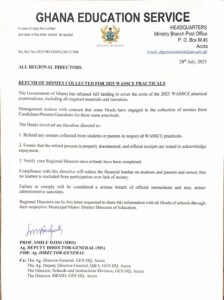
A circular dated 28th July 2025, signed by Prof. Smile Dzisi (Mrs), Ag. Deputy Director-General (Management Services), underscores that the Government of Ghana has released full funding to cover every cost associated with the 2025 West African Senior School Certificate Examination (WASSCE) practicals.
This funding includes all materials and resources needed for the examinations, leaving no justification for any form of financial demand from candidates or their families.
Why the Refund Directive Was Issued
Despite the government’s financial commitment, the GES observed with concern that some Heads of institutions have gone ahead to collect monies from students, parents, and guardians. These collections were supposedly to fund the same practical examinations that the government had already budgeted for.
Such actions not only violate official policy but also place unnecessary financial pressure on students and parents, particularly those from economically challenged backgrounds.
In light of these concerns, the GES has issued a clear and uncompromising directive to halt the practice and begin immediate refunds.
Key Instructions from the GES Circular
The directive to all Regional Directors and Heads of Schools outlines three core actions to be taken without delay:
1. Refund All Monies Collected:
Heads are required to immediately return any monies collected from students or parents for the purpose of funding WASSCE practicals. This ensures fairness and protects the interests of students and families who may have already made payments.
2. Document the Refund Process:
The GES insists that the refund process must be thoroughly documented, with official receipts issued to confirm that repayments have been made. This will serve as evidence of compliance and transparency.
3. Notify Regional Directors After Refunds:
Once refunds have been completed, Heads of Schools must formally notify their Regional Directors, confirming that all steps have been taken as directed.
These measures are intended not only to enforce accountability but also to promote a culture of trust and proper financial conduct within the school system.
Impact on Learners and the Educational Community
This directive is expected to reduce the financial burden on parents and students, many of whom already face significant economic challenges.
By eliminating unofficial costs associated with examinations, the government aims to ensure that no learner is excluded from participating in the WASSCE due to lack of funds.
It also reflects a larger policy commitment to equal opportunity in education, a principle that has guided the Ministry of Education’s recent reforms and funding strategies.
Consequences for Non-Compliance
The GES has made it clear that failure to comply with this directive will attract serious consequences. Heads of Schools who refuse or delay the refund process will be seen as committing a serious breach of official instructions, which may result in administrative sanctions.
Such penalties may include disciplinary actions, removal from post, or other measures deemed necessary to preserve the integrity of the education service.
Role of Regional Directors
Regional Directors of Education have also been tasked with a vital role in this process. The GES has requested that they:
1. Disseminate this information to all Heads of Schools under their jurisdiction.
2. Ensure compliance through monitoring and reporting.
3. Collaborate with District, Metro, and Municipal Directors of Education to guarantee that the directive reaches every corner of the country.
This decentralized approach ensures that the refund process is swift, coordinated, and effectively monitored.
Upholding Educational Integrity and Trust
This move by the Ghana Education Service is more than just a directive—it is a reaffirmation of the government’s commitment to equity, accountability, and transparency in education.
By calling out unauthorized charges and insisting on refunds, the GES is sending a powerful message to school administrators: public education must remain accessible and fair to all, especially when government funding is already in place.
It also builds trust between stakeholders—students, parents, schools, and the government—by ensuring that funds meant to relieve burden are not misused or misrepresented.
Summary of Key Points:
1. The Government of Ghana has fully funded the 2025 WASSCE practical examinations.
2. GES has directed Heads of Schools to refund all monies collected from students or parents for these practicals.
3. Refunds must be documented with official receipts.
4. Regional Directors must be notified after completion of refunds.
5. Failure to comply could result in serious administrative sanctions.
6. Regional Directors must share and enforce this directive through Municipal, Metro, and District offices.
Source: quarmsmedia.com