List of Banks and Their Loan Interest Rates in Ghana
Here is the List of Banks and Their Loan Interest Rates in Ghana.
Discover the latest lending rates for household loans in Ghana as of September 2024. Find out which banks have the highest and lowest interest rates, and learn what it means for borrowers in today’s economy.
Access to credit is a vital lifeline for households in Ghana, whether it’s for home renovations, business capital, or personal emergencies.
However, the cost of borrowing measured by interest rates varies significantly across different banks. According to the Bank of Ghana’s Annual Percentage Rate (APR) report for September 2024, there is a substantial gap between the highest and lowest lending rates offered by financial institutions in the country.
In this article, we break down the top 10 banks by their lending rates to households, from the highest to the lowest, and explore what these figures mean for everyday borrowers.
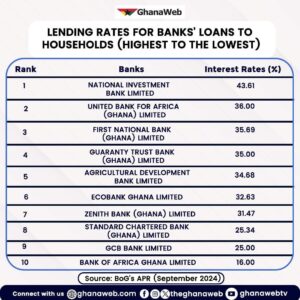
1. National Investment Bank Limited (43.61%)
Topping the list with the highest lending rate is National Investment Bank Limited (NIB), charging a steep 43.61%. This rate means borrowers will face significantly higher repayment costs over time, making NIB one of the most expensive options for household loans.
Such high rates may be due to the bank’s lending risk policies or the type of loans offered, often targeting high-risk borrowers or unsecured lending.
2. United Bank for Africa (Ghana) Limited – 36.00%
In second place is United Bank for Africa (UBA) Ghana, with a lending rate of 36.00%. While notably lower than NIB’s rate, it is still on the high side compared to the industry average.
Borrowers considering UBA for personal or household loans should weigh the convenience of the bank’s wide network against the higher repayment costs.
3. First National Bank (Ghana) Limited – 35.69%
First National Bank Ghana follows closely with 35.69%. Known for its digital banking innovations, the bank still maintains relatively high household loan rates. This may be due to Ghana’s broader macroeconomic environment, where inflationary pressures have pushed up the cost of borrowing across the sector.
4. Guaranty Trust Bank (Ghana) Limited – 35.00%
Guaranty Trust Bank (GTBank) charges 35.00%, placing it among the top four highest lending rate banks in the country. While GTBank is widely recognized for its strong customer service and digital platforms, borrowers need to factor in the repayment burden before committing to loans at this rate.
5. Agricultural Development Bank Limited – 34.68%
The Agricultural Development Bank (ADB), primarily known for supporting Ghana’s agricultural sector, offers household loans at 34.68%. While its mandate leans toward agricultural financing, individuals seeking personal loans from ADB will still face relatively high interest costs.
6. Ecobank Ghana Limited – 32.63%
Ecobank Ghana offers a slightly lower rate at 32.63%. As one of the largest pan-African banks, Ecobank’s strong presence and diverse loan products attract many customers, but the rates remain above the 30% threshold, which is still significant for long-term borrowing.
7. Zenith Bank (Ghana) Limited – 31.47%
Zenith Bank Ghana comes in at 31.47%, making it a comparatively more affordable option than the previous six. However, it is still considered high when compared to some banks at the lower end of the spectrum.
Zenith’s reputation for stability and structured loan products may appeal to borrowers willing to pay this rate for reliability.
8. Standard Chartered Bank (Ghana) Limited – 25.34%
With a noticeable drop in rates, Standard Chartered Bank Ghana offers household loans at 25.34%. This makes it a more competitive choice for borrowers seeking lower interest charges while still accessing premium banking services.
9. GCB Bank Limited – 25.00%
GCB Bank Limited, Ghana’s largest indigenous bank, offers household loans at 25.00%. With its extensive branch network and deep market penetration, GCB’s rate provides a fair balance between accessibility and affordability for Ghanaian households.
10. Bank of Africa Ghana Limited – 16.00%
At the bottom of the list—and by far the most affordable is Bank of Africa Ghana, with an impressively low rate of 16.00%. This makes it the most cost-effective choice among the top 10 banks, potentially saving borrowers thousands of cedis in interest over the loan term.
What These Rates Mean for Borrowers
The wide gap from 43.61% at NIB to 16.00% at Bank of Africa shows that the cost of borrowing in Ghana can vary drastically depending on your bank of choice. Borrowers must carefully assess:
Total Repayment Cost : Higher rates mean significantly higher total payments over the loan’s lifespan.
Loan Tenure : Longer loan periods will compound the effects of high interest.
Collateral & Credit Score : Some banks may reduce rates for secured loans or customers with excellent credit history.
In Ghana’s current economic climate, with inflation and currency pressures influencing lending conditions, these figures highlight the importance of shopping around for the best loan deals.
Tips for Getting the Best Loan Rates
1. Compare Multiple Banks : Don’t settle for the first offer; rates can differ by over 20 percentage points.
2. Negotiate Terms : Some banks may adjust rates for loyal customers or larger loan amounts.
3. Improve Your Creditworthiness : A strong repayment history can help you qualify for better rates.
4. Consider Loan Purpose : Certain loan products (e.g., mortgages) may attract lower rates than unsecured personal loans.
Final Thoughts on List of Banks and Their Loan Interest Rates in Ghana
Here is the Lending Rates for Banks Loans in Ghana as of September 2024.
The September 2024 Bank of Ghana APR data reveals that while some banks in Ghana offer relatively affordable lending rates, others remain prohibitively expensive for the average household.
Informed decision-making, based on careful rate comparisons and repayment planning, is essential for minimizing borrowing costs.
If you’re planning to take out a household loan, this list serves as a valuable starting point for understanding where each bank stands and how much you might pay in the long run.
Source: quarmsmedia.com